Showing posts with label Religion. Show all posts

Friday, March 2, 2012

A Brief History of Qigong

So last week while looking into Falun Gong I kept running up against two rather strange walls. The First was why the CCP would allow something like Falun Gong to exist in the first place, let alone grow as large as it did. And second was the concept of Qigong. While I have had a general understanding of what Qigong is for a while now and I was aware that Falun Gong is an off branch of Qigong which combined elements of Buddhism and Taoism with the practice of Qigong, I wasn't entirely sure how it fit into Chinese history as a whole.

So what did I do? Well I went to the library of course!
I which my life was as cool as this show
So what is Qigong? Well that's a pretty complicated answer, but in short Qigong is based on Chinese folk traditions based on breath, movement, posture, and control (kind like yoga but different). The tradition as a whole collection of various practices stretches back about 4000 years. However, in the 1940s and 50s the CCP began to combine various elements of the tradition based on the health, wellness, and scientific benefits of the traditions. Why?

Well the things was Mao (and many other communist leaders) acknowledged that although Chinese history was filled with feudalism and imperialist oppression it was also filled with beneficial practices, ideas, and medicinal techniques which should be researched, understood, and utilized by the new republic.

One of the ideas which was examined and valued was the traditions that would become Qigong due to traditional claims of health benefits surrounding the practices. Qigong progressively had it the philosophical and religious aspects of it were removed and over the course of the next decades Qigong was modified, streamlined, and changed even further by the huge social changes that tore through China.

While this could seem like this wasn't as interesting project as my previous research topics, I was really excited to go into this particularly because I felt lost in my work with Falun Gong. So this topic rose out of my need to answer the question where on earth did Falun Gong come from/gain that support to become as widespread as it did. Which, considering the fact that Qigong is practiced by millions of people to this day, now makes a lot more sense to me. Additionally it makes sense that the CCP would crackdown on Falun Gong because, unlike Qigong, it was in no way regulated or controlled by the party meaning that it subverted much of the party's main stream views of religion.

In terms of lingering questions I'd be curious to learn more about the traditions that Qigong is based in addition to Qigong itself. Especially the religious aspects although modern Qigong used to based on Qi, the party is currently criticizing it for that and the practice is beginning to refocus on the health and medicine aspects of it, I'm curious in seeing what the non-party version of the story is.

Well that's all from me today!
Peace and Love
Jacob

Sources:


Chang, Maria Hsia. 2004. Falun gong : The end of days. New Haven [Conn.]: Yale University Press.

Howell, Jude. 2004. Governance in china. Lanham, Md.: Rowman & Littlefield Publishers.

Ownby, David,. 2008. Falun gong and the future of china. Oxford; New York: Oxford University Press.

Palmer, David A. Qigong Fever: Body, Science, and Utopia in China. New York: Columbia University Press, 2007.

Sunday, February 26, 2012

Catching Fire: Political Unrest and Oppression in Tibet


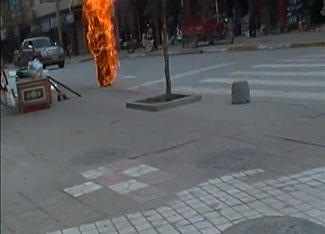
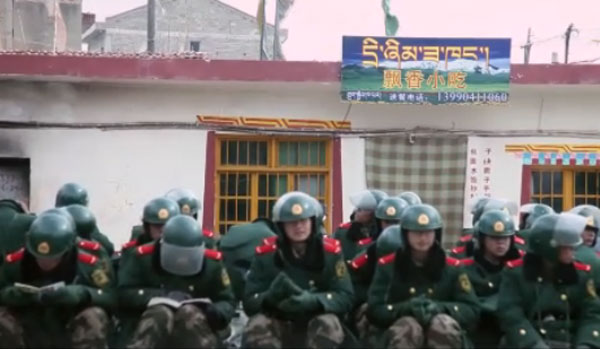
I think those two photos sum it up best. Tibet is burning and tensions are beginning to mount. According to the BBC currently 21 monks have set themselves on fire in the past few months in protest of myriad of issues concerning Tibetian Chinese relations, but, in this situation at least, there are two of cardinal importance. As I mentioned last time the recent restrictions in the area around Tibet 'proper' has sparked this second wave of protest, but what are the restrictions? Well that's the second point many of the monks, nuns, and Tibetans in general feel that China is deeply restricting their freedom of expression, religion, speech, and movement.  China's response to these claims? 


Notice the fire extiquisher 

There are dozens of photos and this post could could become a photo journal from here on out, but that would miss the point. China is cracking down hard against the Tibetians labeling them separatists and terrorists and they will continue to do so until their goal of security is reached. Regardless of who you think is right in this situation people are being beaten, restricted, watched, and (perhaps most importantly) dying by their own hand or otherwise. And China's actions aren't helping. But then again China has dealt with religious protests similar to this before and in a similar manner I might add. 

Each time China has successfully put down the protests and, for the most part, managed to eradicate the memory of what happened from the public's mind. So, in many ways, this crackdown makes a lot of sense it worked before so it will work again, at least that's what the Chinese government is banking on. And while a large part of me if fearful that this will be a replay of what's gone before part of me is hopeful for some change.After all if you'll remember Chinese geomancers did predict that several Party officials would wind up behind bars by years end.

Take away questions? Well this time I guess I'm very interested to see how this situation develops and I'll be watching it as closely as I can in the days and weeks to come.

In loving memory of the dead, may you find what you seek:

Jacob 
Further Reading:

A good profile of Lama Sobha (one of the first to light themselves on fire) warning the article contains graphic images of his body: http://www.savetibet.org/media-center/ict-news-reports/photos-lama-sobha

Articles mentioned
Video courtesy of the Guardian 

Sunday, January 29, 2012

The Religion of Void

Well I know I've been saying for the past few posts that I'd be talking about Daosim this time but it seems that I've run into a bit of a quandary. You see in South Korea, which is my current area of focus, Daoism, which is my current religious focus, never really came to party. Or for that matter they never really got the invitation. So now you see my quandary, how I am to talk about my focus religion in an area where it doesn't have to strong a sway? Well I simply re-framed my question into finding out why Daoism wasn't in Korea and while I was digging about I came across Muism also known as Korean Shamanism. So I my next hunch was that the popular religion of Korea repelled attempts at the implantation of Daosim into Korea but then I did a bit more research and saw that was flat out wrong.

You see throughout much of its history the nations inhabiting the Korean peninsula have been influenced by their neighbors in China. From tribute to their governing system to Korea's faithful payment of tribute for several hundred years a great deal of cultural exchange occurred including the importation of Confucianism and, later, Buddhism. But strangely Daoism never arrived on the scene. But, then again, on closer examination it might not be so strange. You see while Daosim did enjoy a brief time as an organized religion that was favored by the Imperial Chinese Court it was, has and always shall be, a much more populist tradition. Which is important for two reasons, the first is that it never became attached to the Court and second there was no easy way for Daoists to spread their beliefs.

To flesh those out a bit because of its structure and doctrine Confucianism was used to help support much of the later Chinese Dynasties bureaucratic system. Meaning that Confucian ideals were exported to countries closely under the sphere of Chinese influence, like Korea.
Poor man
Additionally Daoism isn't exactly the kind of religion which is bent on spreading itself to all corners of the globe and when combined with their lack of a position to even attempt to do so on a large scale it didn't really happen (unless it went through Mahayana Buddhism which was a syncretism of Buddhism and Daosim).

So with that out of the way what about Muism? Well I still don't know a lot about it yet but i am still investigating. Within Muism there is a group of people know as mudang who serve as the 'shamans' (whether or not Muism is shamanism at all is up for debate) and act as intermediaries, interpreters, and vessels for interaction between humans, spirits, gods, and a host of others.

However, there are two very interesting things about the mudang the first they almost all female and second it is not something you choose it choose you. At a certain point in someone's life they will become horrifically ill, struck down with a divine illness. This illness could go on for some time before the person begins to feel a sort of calling that must be answered or they will be drawn further and further into the sickness. And often times they have to answer the call in potentially the most epic ways.
One guy was bed ridden for days until he got up and
climbed to the top of anearby mountain in the middle of blizzard. 
Eventually the mudang is possessed by the first time by the deity that had been calling to them. After this they set out establishing themselves in their communities.

While the idea of a vocation is something I have encountered in my studies I have never run into something like this before. True I have heard that epileptics are more likely to have intense religious experiences and callings akin to these but there is no way that such a condition could be concentrated in Korea to such a degree that an entire popular religion was built to accommodate it. Or else every culture would have more classes of spiritually torn people who either literally have to make peace with a hast other worldly power or potentially die from the illness that comes with this calling and while I know many a person with a religious calling I have never seen them collapse in the street because of the intensity of its nature.

So I guess my next steps are to dive further down this rabbit hole and try and figure out why the mudang are this way? Why is it a mostly female class? Why are the visions so intense in nature? What are the gods like? And can you ever know you are going to be a mudang before it happens?

Till next time

Sources:


Grayson, James Huntley. Korea: A Religious History. New York: Routledge, 2002.

Walraven, B. C. A. 1983. Korean shamanism. Numen 30, no. 2: 240-264.

Walraven, Boudewijn. 2009. National pantheon, regional deities, personal spirits? mushindo, songsu, and the nature of korean shamanism. Asian Ethnology 68, no. 1: 55-80.

Wong, Eva. The Shambhala Guide to Taoism. Boston: Shambhala, 1997.

The Dragon at Midnight

Happy New Year! Again!

That's right folks although the first round of holidays is over for this season we have just entered the second wave of new years. Earlier this week China, South Korea, and other portions of the world influenced by Chinese culture roared in the year of the Dragon, which is a most auspicious year indeed.

In fact so much so that everyone throughout this region is trying have as many babies as possible and several of the governments are encouraging them to do so. Take Singapore for example the PM Lee Hsien Loong said, and I quote, "I fervently hope that this year will be a big Dragon Year for babies... This is critical to preserve a Singapore core in our society,"
The family with the most will be able to associate with
them  
in public for a year with out being imprisoned 
And for those of you who find the encouragement of reproduction a silly purusit because the world is going to end on December 21st worry not because some Chinese geomancers are convinced that shits going to get real this year to. To the point that one predicted that some government officials would be stepping down...I can just smell a who new dimension of time wave zero conspiracy theories brewing as I write this.
I really hate that man
So what does this have to do with religion? Well everything really. Unlike here in the United States where we have completely commercialized our New Years celebrations there is still an element of the religious that permeates the other new year celebrations that are sprinkled through out the year from the Four Jewish New Years (one of which is coming up in two weeks) to the Chinese Lunar New Year. And while many of these celebrations have been changed to fit out more materialist mind set (many Chinese took the day off to go shopping in Japan) it is interesting to notice the difference in tone between the contexts of various new year celebrations. The fact that multiple major governments are bracing for a baby boom year because of the ascendance of the Dragon is evidence enough of this. But what is ever more interesting in my opinion is the vary same conspiracy theory i just bashed. While I might disagree with the western doom profits who combine things like the I-Ching and the Mayan calander and declare that the end is nigh in December, I would like to point out that its rather interesting that many people are proclaiming the importance of this year. And I think I agree with that. From the social uprisings all around to the continuing police brutality in Oakland
Yesterday!
the effects of 2011 are still panning out in an unpredictable way and something very very big is going to happen. And if doesn't? Well I guess I'll just go live in the desert.

In terms of what I'd like to learn next? How does the Chinese Calendar work? Cause I have no goddamn idea.

Till next time, when we actually will talk about Daoism
Jacob

Don't know who Terrence Mekanna is? Good! You're much happier.